
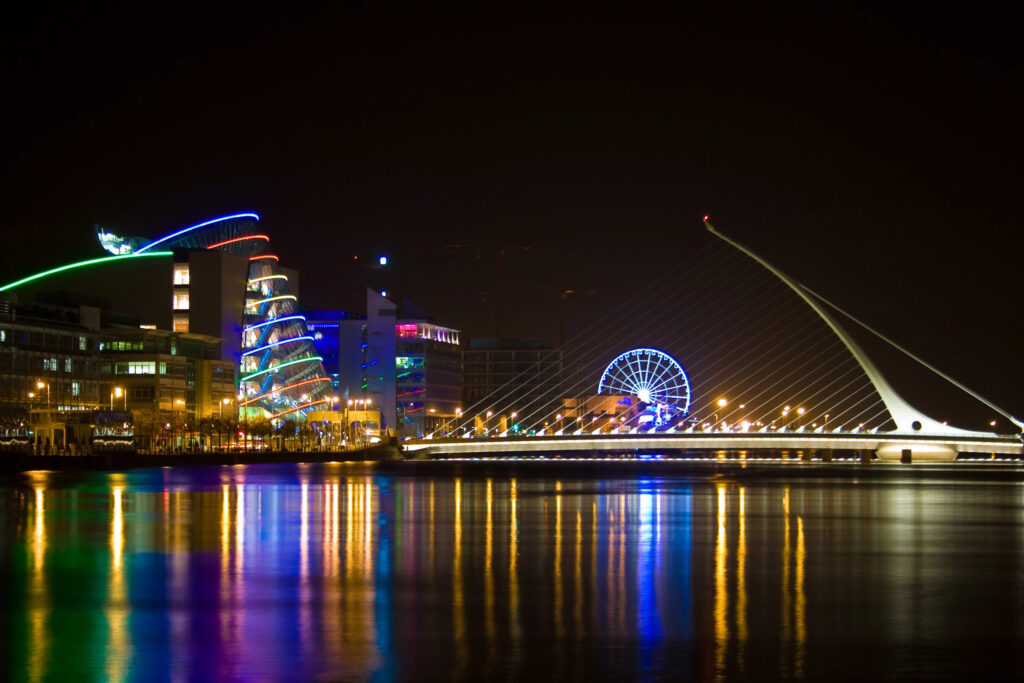
A white harp is lying on its side across the Liffey. At least, that’s one reading of the Samuel Beckett Bridge. Show it to a small child and you might get a dinosaur with its ribs on the outside. Either will do. The question worth saving for when you get closer is how on earth a ship gets past it.
That bridge is the halfway treat on a family walk through Dublin’s Docklands. Start at the old warehouse on Custom House Quay, follow the north side of the river east and finish around Dublin Landings. Along the way there’s a gold building, an enormous piece of public art and a surprisingly good answer to the question of where the rain goes. Everything you need to see is outdoors or visible from the street.
Start at CHQ with a pocket-sized map
Meet outside the CHQ Building on Custom House Quay, close to the George’s Dock stop on the Red Line Luas. Allow about an hour for the outing if your children like to stop and look. That’s an allowance for dawdling, rather than a time to beat. For a shorter walk, go as far as the Samuel Beckett Bridge and come back. For the longer version, the Spencer Dock Luas stop on Mayor Street Upper gives you an alternative to retracing the whole route.
A scrap of paper folded in half makes a better map for this particular walk than a list of things to tick. Draw a blue line for the river. Put a square at one end for CHQ and leave the rest blank. Hand it to whoever usually objects to holding the map because the writing is too small. They can add their own landmarks, upside down or in entirely the wrong place. You keep the job of finding the crossings.
Give CHQ a minute before setting off. From outside, ask what anyone could have needed such a long building for. Its riverside address is a clue. The history of the CHQ Building describes how cargoes including tea and tobacco were stored here. Try explaining a warehouse to a little one by asking where a whole shipload of tea would go if the shops could only take a few boxes each. Suddenly all that space seems quite reasonable.
If the building is open, take a quick look up. The frame that carries the roof is cast iron. A child who has drawn a brick box on the map might like to give it a second, secret drawing inside. If you stay outdoors, the view along the brick wall gives you plenty to work with. Let the person with the map choose a symbol for tea that they’ll recognise on the way home.
See who can make the bridge turn
Head east with the Liffey on your right. There’s no need to cross to the south bank. Use the pedestrian crossings at junctions and keep little ones beside you along the quay. On this stretch a good place to stop is one where everyone can stand clear of the cycle path and look up without having to shuffle out of someone’s way.
Let the bridge come into view before you tell anyone what it’s called. From a little way back, you can see the whole sweep of the white support and its cables. Up close, parts of it disappear above your head. If the children want a photograph, take the first one from farther away. Then let them pick a detail for a second picture. It’s quite a surprise how hard it is to recognise your own bridge from one little patch of white.
Now bring back the ship question. Hold one hand flat as the bridge and use the other as a boat too tall to fit underneath. Let your child try a solution. Lifting your fingertips makes a perfectly respectable opening bridge. Dublin’s version has a different trick. As Dublin City Council explains, the Samuel Beckett Bridge can swing through a quarter turn. Turn your flat hand sideways to leave a gap for the boat. You can show the whole thing in ten seconds, even on a day when the real bridge stays put.
For a child who wants one more improbable detail, the bridge’s superstructure travelled here from Rotterdam on a barge. Let that sink in. The bridge that lets boats through was once cargo itself. That’s usually a better point to break out the snacks than to try and remember what it weighs.
Find the building wearing a sun hat
Carry on along North Wall Quay to the Central Bank of Ireland. The gold-coloured mesh is easy to pick out. Give the children a moment to notice the gaps in it. Why would somebody go to the trouble of putting a screen across a lovely big window, then leave so many holes? Ask them to cup a hand over their eyes as if they’d forgotten their cap. They can still see out, even though their hand cuts the glare.
The mesh helps limit how much heat from the sun reaches the building. A child might decide the bank is wearing a very expensive sun hat. It’s a good explanation to take away. If an older child presses you on what happens inside, the Central Bank’s building energy management system controls equipment including fans that move air around the occupied rooms. The engineers also fitted controls for daylight and temperature. The gold screen is the part you can point to from the street. The fans and controls are the part you have to imagine.
There’s a nice drawing to be had here for siblings who rarely agree on a subject. Give one the outside and the other the inside. One may spend five minutes getting the gold pattern right while the other sketches an enormous fan next to somebody’s desk. Put the two halves together. You’ve got a cutaway drawn by two people who stood in exactly the same place and saw quite different buildings.
Give the sculpture a name of its own
Outside the bank, look for the brightly coloured steel sculpture. Keep its name to yourself for a moment. Each person gets to invent a title, and the youngest goes first. Once an adult has said “spider”, it’s remarkably hard for anyone else to see anything other than legs.
Walk a little way around it on the public space. Pick one coloured length and follow it with your eyes. Does it belong to the same shape you thought it did from the other side? This is a good place to let a child direct a photograph. Give them the choice of where you stand and what gets left outside the frame. You can hold the phone while they make all the important decisions.
The artist is Eva Rothschild and her title is A Double Rainbow. Give everyone a chance to argue for their own title anyway. The most interesting answer may come from the person who can’t quite explain theirs and has to take you back to the exact spot where it made sense. Add that name to the family map. A brother or sister who missed the outing has a fair chance of finding the sculpture from that clue alone.
Follow a raindrop at Dublin Landings
The last outdoor stop is Dublin Landings, the development on North Wall Quay around New Wapping Street. Stay on the public pavement and pick out a roofline. Ask where a drop of rain landing up there would be a minute later. On a familiar house you might trace a gutter round the eaves and a pipe down the wall. Following that same drop on a block with several terraces is a different proposition.
Give the mapmaker room for a side view. Draw three roofs, one above the other like steps, and put a big blue dot on the highest. Let them draw a route down. What happens if their first pipe ends directly over the front door? Where could it go if the people designing the building wanted to bring the water to one side? An enthusiastic child can spend a surprising amount of pencil lead trying to keep an imaginary visitor’s shoes dry.
There’s a real answer for three of the blocks here. The engineers designed the siphonic roof drainage at Dublin Landings to carry rainwater from the main roofs to one side of the buildings. The team used gravity drainage for the lower podium. For a child looking up from street level, the interesting bit is that the water falling on different parts of the same development can take different routes. Nobody has to spot a hidden pipe to solve this clue.
On a wet day, offer a much smaller puzzle before you head for cover. Look down at a single paving slab from where you stand. Can you tell which way it slopes from the direction a trickle travels? On a dry day, leave the blue dot on the map and try the same question outside your own front door after the next shower. It’s a Docklands souvenir that works equally well at home.
Choose your finish before everyone gets tired
On a weekday, the bank’s free visitor centre gives you an indoor option near the end of the walk. Check the visitor centre’s opening times and facilities before promising it to anyone. It closes at weekends and on bank holidays. There’s an accessible toilet beside the centre. If you’re already at the bank with a child who needs a break, swap the last two stops or make this your finish.
For a wet weekend, you have another option back where you started. EPIC The Irish Emigration Museum is inside CHQ and is a separate, ticketed outing. Dolly Dowsie’s guide to rainy day activities in Dublin for kids gives you a feel for it, including the passports children can stamp as they go. If you’ve already had a good hour outside, save the museum for a day when everyone has the appetite for it.
On the Luas home, pass the paper map to someone who didn’t draw it. Can they tell which shape was a warehouse and which was supposed to spin? Ask the artist about the mark you can’t identify. If it turns out to be the spot where the biscuits came out, leave it in. That’s a perfectly good landmark when you’re seven.


