The best garage tool storage system is the one that integrates various storage solutions that mirror your unique workflow and inventory. The point is to analyze the tools you possess, your habits, and the garage ecosystem itself. The goal is not merely to store but to create a frictionless tool storage system for garage use where every tool has a dedicated place and can be accessed in seconds. So, let’s get the hang of the most common garage tool storage solutions and what they can offer to meet your needs.

Photo by Anton Savinov on Unsplash
The Common Types of Tool Storage Systems: Core System Archetypes
Garage storage comes in three main archetypes, each serving a distinct functional and spatial purpose. The most effective garage plans strategically combine elements from all three.
Mobile Storage
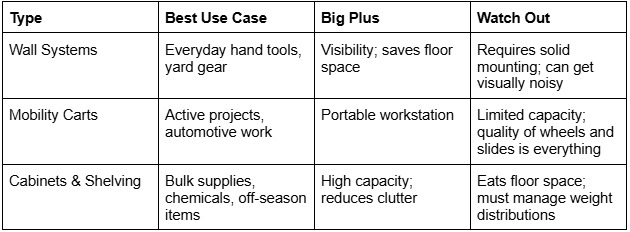
If you're working all over the place - in the yard, the driveway - hauling tools back and forth to a stationary cabinet gets complicated. That's where heavy-duty rolling tool chests or mechanics' carts change everything. Wheels, a spot for each tool, even a hard top you can work on - these carts are built for people who actually use their tools. No more endless trips looking for things you've left somewhere else.
When you pick a mobile toolbox, focus on where you're using it and how you're getting it there. Big air-filled wheels roll over cracks and gravel; small, swivel wheels are smoother if your garage floor is pristine. How the drawers open matters too - full-extension runners with ball bearings mean you won't have to wrestle a stuck drawer when it's loaded up. Ideally, your mobile storage should complement what's on the wall: tool carts for your most-used tools, wall or cabinet storage for overflow, and items you rarely use.
Wall-Mounted Systems
For some reason, garage owners often forget about the garage walls. Most of the time, they're just blank space. But set up the right wall-mounted system and suddenly you've got a storage setup that actually works. Think slatwall (basically fancy pegboard), metal grids with hooks, or those solid French cleat rails. The big win? You can see your tools - no more digging through piles or guessing where things went. Everything is easy to reach, and you're not tripping over stuff that should be put away. Plus, you get actual floor space back for working on projects or parking the car.
Of course, the details matter. Cheap pegboard is fine if you want to hang up garden gloves or a couple of screwdrivers, but it doesn't hold up for anything heavy. For real support, you want heavy slatwall or metal grids - they'll handle shovels, ladders, even a wheelbarrow. The French cleat setup's basically in a league of its own; with angled rails mounted to the wall, you can move brackets around wherever you want and trust they'll hold just about anything you throw at them. Still, pay attention to how much weight your panels and the hardware can handle - don't trust drywall anchors with heavy gear. If you're hanging more than a whisk broom, screw directly into the studs.
Freestanding Cabinets & Shelves
Wall hooks put things on display, and carts get tools where they're needed, but at some point, you need to hide the mess. That's where sturdy cabinets and heavy shelves come in. They're built for the items nobody wants to see: paint cans, power tool cases, old hardware, whatever random auto fluid you've collected. Closed metal or tough plastic cabinets keep out dust - pretty important if you're storing sensitive gear or trying to keep sawdust away from laundry machines. Steel shelves don't care what you throw at them and are great for stacking up bins or sorting things warehouse-style.
Cabinets or open shelves? Kind of a style call - shelves are cheaper and fast to set up, but everything's out in the open. Cabinets look cleaner, so if your garage doubles as a mudroom or a place you actually spend time, you might prefer them. Either way, keep heavier stuff down low so the whole thing doesn't tip - low center of gravity is your friend. Modular cabinet setups that you can rearrange or expand make life easier in the long run, especially if your garage routine changes over time.
Garage Storage System Comparison Table
Plan Before Shopping
Start with a real inventory. Lay it all out: what kind of tools and equipment are stored in your garage? Sort by how often you pick something up. Your daily tools should live on the wall. Stuff you use less goes in bins on shelves. That one-off tool? Goes up high and out of the way.
Think in zones, not just storage. The garage isn't just one big room - it's a set of mini-workshops combined. If you keep jack stands, put them by the car. Sandpaper and clamps should be kept near the saw. When you set things up like this, you'll walk less - by a lot. It's the easiest time-saver most people overlook.
Don't skip on durability. Garages will test everything you put in them: heat, cold, moisture, maybe a runaway lumber cart. Cheap particleboard turns to mush. Go with powder-coated steel, thick plastic bins - stuff that's built to survive. Anchor anything tall, too. Tipped cabinets aren't just a mess; they're dangerous.
The Final Word
So what is the best garage storage setup? It's always a mix of various tool storage solutions - each one does a specific job. A French cleat wall over a heavy-duty workbench. A rolling cart tucked underneath, ready to go. A line of sealed cabinets for messy supplies. The wall for instant access, the tool cart on wheels for mobility and the metal cabinets for containment. When things change - and they always do - the setup can shift with you.