
Sensory play at Christmas is great for keeping playtime magical and fun with little ones in the run up to the festive season.
December is already filled with interesting things for little hands, eyes, noses and ears to discover. There are twinkling lights, crinkly wrapping paper, pinecones, Christmas music, the smell of baking, evergreen branches and all sorts of interesting textures that aren't usually around for the rest of the year.
So rather than buying lots of special Christmas activity supplies, why not use some of that everyday Christmas magic for play?
I've gathered 25 Christmas sensory activities for toddlers and preschoolers that are simple, playful and easy to adapt to what you already have at home.
You'll find Christmas sensory bins, playdough activities, water play, messy play, fine motor ideas and quieter sensory invitations.
And most importantly, you absolutely do not need to do all 25.
Pick two or three that make you think, my child would love that, and forget the rest.
Christmas with little ones is busy enough already.
What Is Christmas Sensory Play?
Sensory play is simply play that gives children opportunities to explore using their senses.
That might involve touching, pouring, squishing, smelling, listening, scooping, squeezing, sorting or investigating different materials.
And it doesn't have to involve an elaborate sensory bin.
A toddler exploring a pinecone, a preschooler rolling cinnamon playdough, a child pouring water between cups or little hands scrunching leftover wrapping paper can all be sensory experiences.
At Christmas, we can give familiar activities a festive twist using materials and objects already appearing around our homes.
A Quick Note About Sensory Play and Safety
Always choose materials that are appropriate for your individual child's age and development, and supervise sensory play closely.
Small objects such as bells, beads, pom-poms, buttons and miniature Christmas decorations can be choking hazards and aren't appropriate for children who may put them in their mouths.
Also be cautious with long ribbons or strings, magnets, button batteries (these can be lethal to a child), glass ornaments, artificial snow, essential oils and non-food decorative materials.
For younger toddlers, bigger and simpler is usually better.
Water, cardboard, fabric, large wooden objects, taste-safe doughs and other familiar materials can create wonderful sensory play without needing lots of tiny pieces.
Now for the fun part.

Easy Christmas Sensory Activities
1. Christmas Playdough
Sometimes the easiest way to create a Christmas activity is to take something your child already loves and give it a tiny festive twist.
Playdough is perfect for this.
Use your favorite homemade dough or playdough you already own and add a few large Christmas cookie cutters.
Children can:
• roll the dough
• squash it
• make Christmas trees
• cut out stars
• make pretend cookies
• build snowmen
• press patterns into it
If you're making your own dough, a little cinnamon can give it a wonderfully Christmassy smell.
You don't need red, green, white and glittery dough in individual jars.
One ball of dough and a Christmas tree cookie cutter can be enough.
Budget tip: Look through your baking drawer before buying Christmas playdough accessories. Cookie cutters, rolling pins, muffin tins and wooden spoons make excellent play tools.
2. Decorate Playdough Christmas Trees
Roll green playdough into simple tree shapes and let your child decorate them.
Preschoolers who can safely use small loose parts might enjoy adding suitable craft materials.
For younger toddlers, keep things much larger and simpler. They can poke the dough with a wooden spoon, make fingerprints, add large dough balls or press a chunky Christmas cookie cutter into it.
There's no correct way for the finished tree to look.
If your child's Christmas tree ends up horizontal, completely squashed and covered in fingerprints, sensory play has still gone perfectly.
3. Christmas Texture Basket
This is one of my favorite Christmas sensory activities for toddlers because it doesn't need to make a mess.
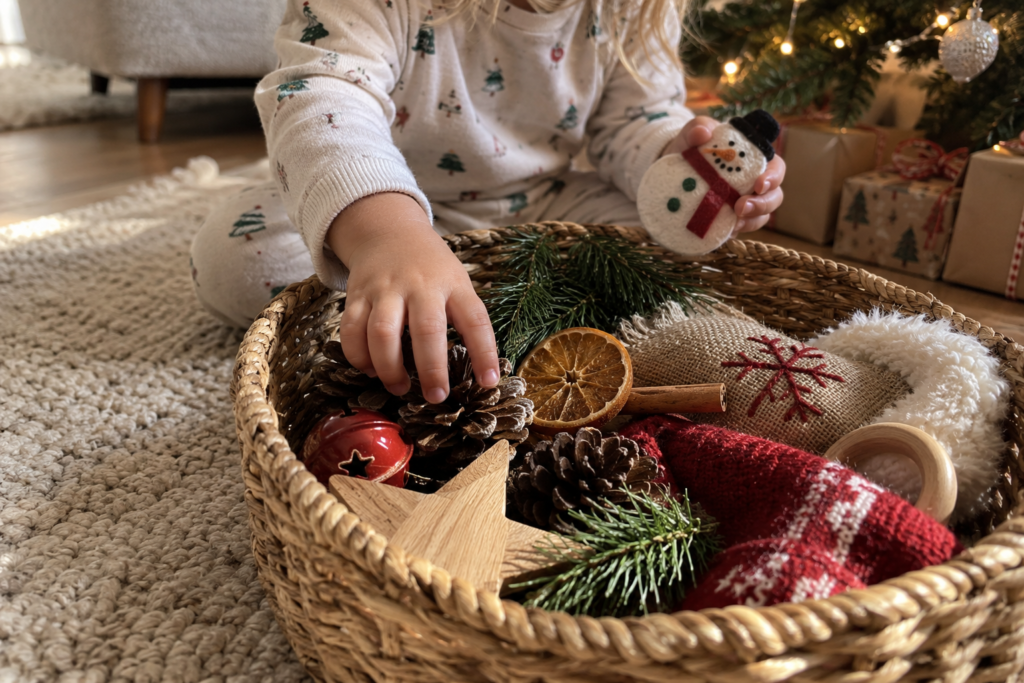
Put a few large, safe objects with different textures into a shallow basket.
You might use:
• a large pinecone
• a soft Christmas stocking
• a wooden star
• a chunky knitted mitten
• corrugated cardboard
• a large piece of felt
• a soft washcloth
• an evergreen branch to explore together
Sit with your toddler and investigate.
Which one feels soft?
Which is rough?
Is the pinecone prickly?
Does the cardboard feel bumpy?
There's no need to quiz your child. Simply use descriptive words naturally while you play together.
4. Wrapping Paper Sensory Play
Do not throw away those awkward scraps of Christmas wrapping paper just yet.
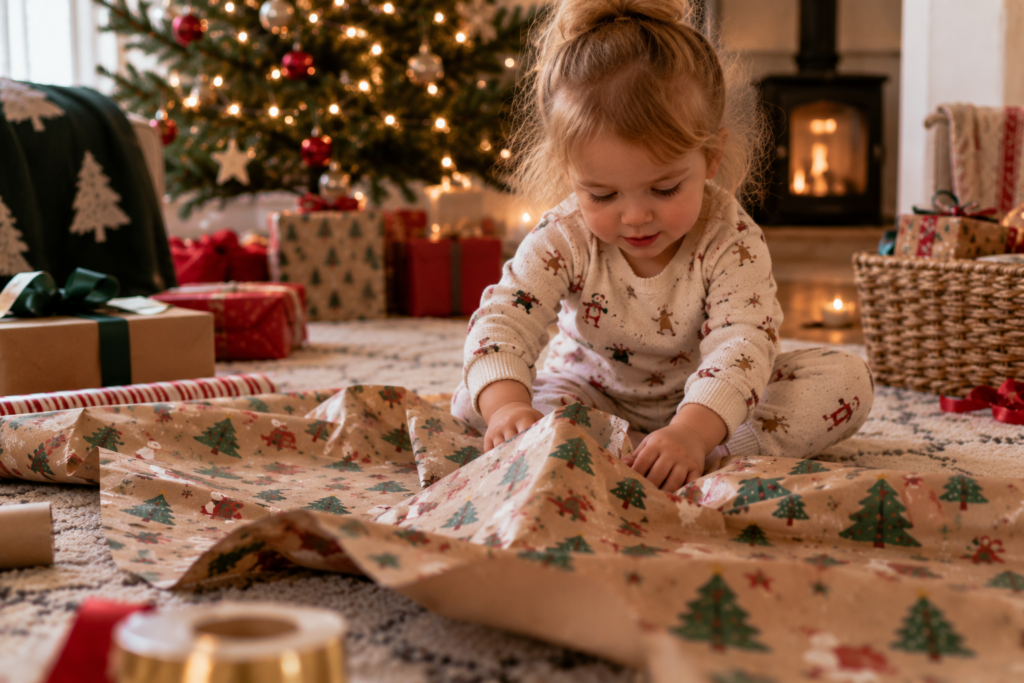
Put several large pieces on the floor and let your toddler explore them.
Scrunch them.
Tear them.
Flatten them.
Hide a teddy underneath them.
Put the pieces inside a cardboard box.
Wrap a toy.
Unwrap it.
Different papers make different sounds and have different textures, making this an incredibly simple Christmas sensory activity that costs nothing.
It's also a good reminder that children's play doesn't have to look elaborate to be worthwhile.
Sometimes the wrapping paper really is more interesting than the present.
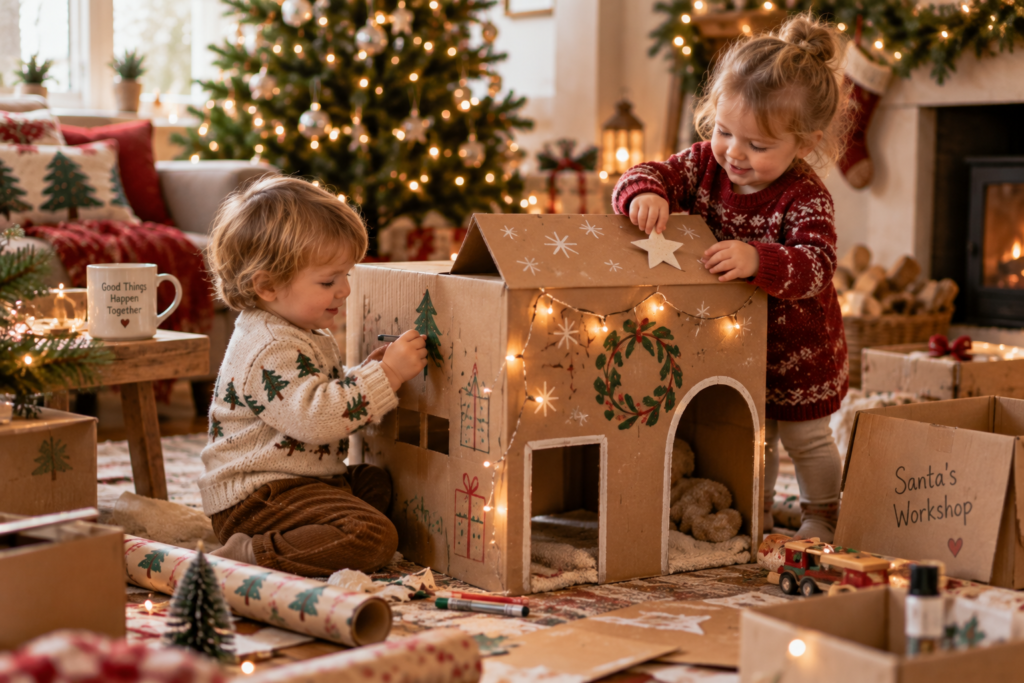
5. Christmas Cardboard Box Play
December tends to bring cardboard boxes into our homes whether we asked for them or not.
Before recycling them, turn one into sensory play.
Toddlers can climb into a large box, hide toys inside it or fill and empty it with crumpled wrapping paper.
Preschoolers could help transform a larger box into:
• Santa's workshop
• a gingerbread house
• a sleigh
• a Christmas post office
• a house for the elves
Give them crayons or washable paint and let the box evolve.
It doesn't need to look Pinterest-perfect.
The box is there to be played with.
Christmas Sensory Bin Ideas
6. Simple Christmas Sensory Bin
A Christmas sensory bin doesn't need 17 different fillers and a collection of miniature Christmas toys.
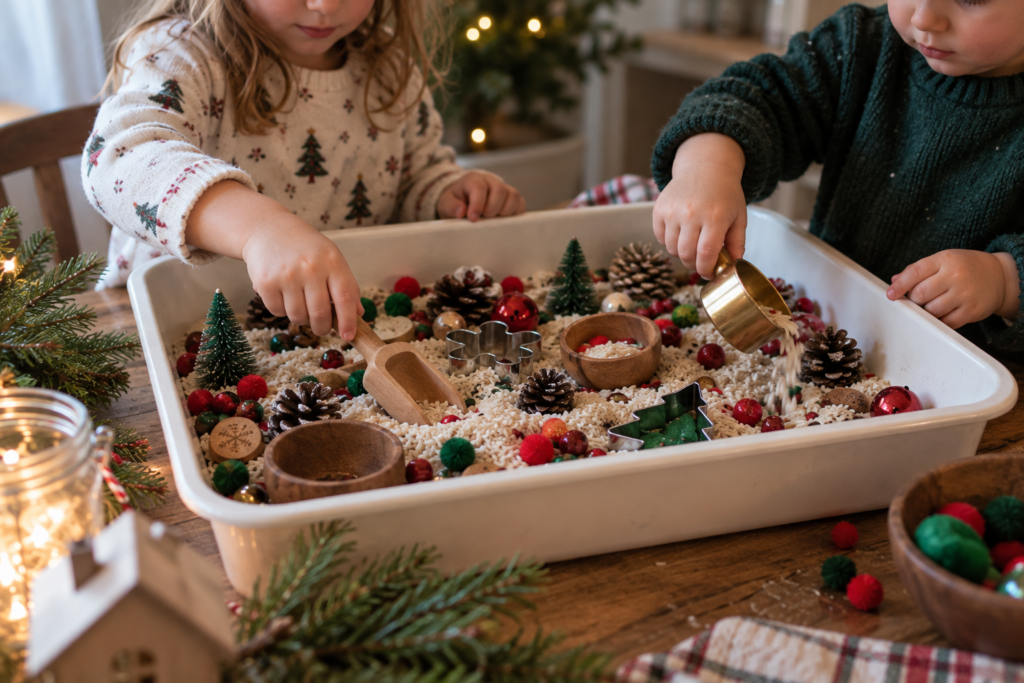
Start with one sensory material your child already enjoys and is developmentally ready to use.
Then add a couple of scoops, cups or containers.
That's enough.
Older preschoolers might enjoy a festive setup involving age-appropriate loose materials and larger Christmas objects.
For toddlers, you can skip small dry fillers entirely and use water, fabric, large pieces of crumpled paper or another safe sensory base.
The important part is the play: scooping, filling, pouring, transferring and exploring.

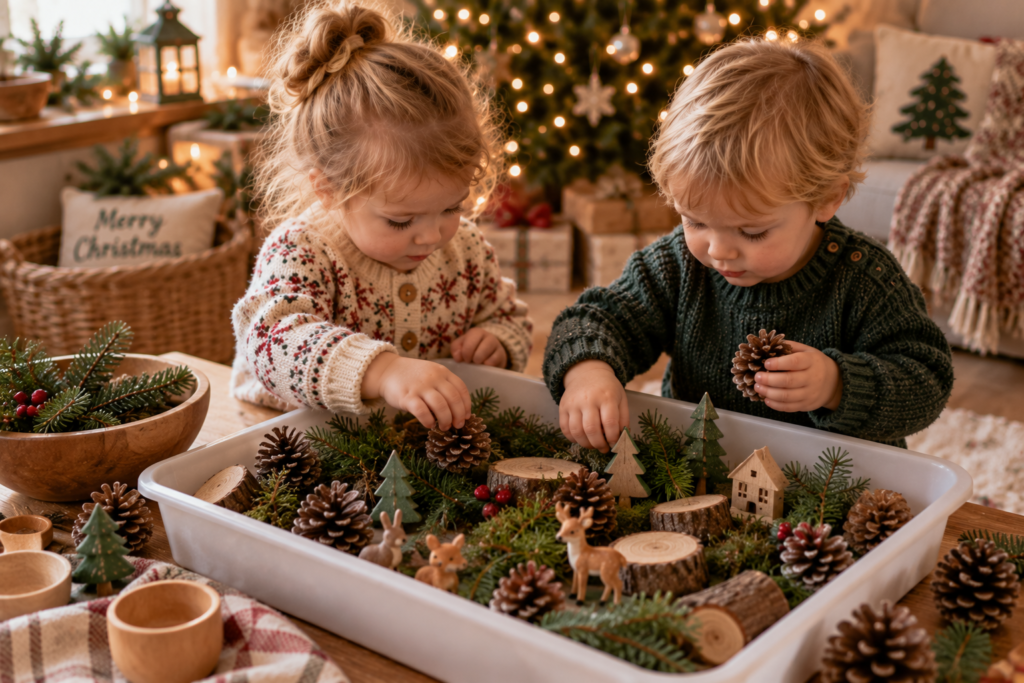
7. Christmas Nature Sensory Bin
Bring a little of the outdoors inside.
After a winter walk, gather a few interesting natural materials together.
Depending on what's available where you live, you might find:
• pinecones
• evergreen clippings
• twigs
• pieces of bark
• fallen leaves
• large seed pods
Put them in a shallow tray and let your child investigate them with you.
Older preschoolers can sort the materials, build little Christmas trees or use them in imaginative small-world play.
This is one of those lovely activities where the walk to collect everything is half the fun.
8. Snowy Christmas Small-World Play
Create a little winter world for preschoolers using a child-safe sensory base and toys you already have.
Add some toy animals, trees, blocks or little figures.
Instead of buying a special Christmas small-world set, see what you can repurpose from the toy box.
A block can become a present.
Toy animals can become Santa's helpers.
Building bricks can create a North Pole workshop.
Children don't care whether every piece came from the same themed sensory kit.
Their imaginations are very good at filling in the missing details.

9. Christmas Scoop and Pour Bin
For children who love transferring activities, keep the setup deliberately simple.
Choose an age-appropriate sensory material and provide:
• two containers
• a scoop
• a cup
• a spoon
Then let them move the material from one container to another.
And back again.
And probably onto the floor.
For younger children, water can be a particularly simple option.
Put a towel underneath the setup and accept from the beginning that some of the water is going to escape.
It saves everyone a lot of stress.
10. Christmas Kitchen Sensory Bin
Raid the kitchen rather than the craft store.
A mixing bowl, wooden spoon, whisk, measuring cups, muffin tin and Christmas cookie cutters can become a wonderful invitation to pretend to make Christmas dinner or bake Christmas treats.
Add playdough for pretend cookie dough if you like.
This is especially good for children who want to be involved when you're doing real Christmas baking but aren't quite ready to help with every stage.

Christmas Water Play Activities
11. Christmas Water Play
Christmas water play can be wonderfully simple.
Put warm water into a shallow container and add a few cups and scoops.
If you have some suitable large waterproof Christmas objects, add those too.
Your child can:
• scoop
• pour
• fill
• empty
• stir
• splash
• transfer
That's it.
There is no need to dye the water red or green or fill it with glitter.
Water is already an excellent sensory material.
Parent survival tip: Put the container on a large towel rather than spending the entire activity saying, "Careful! Don't spill it!"
Spilling is basically the activity.
12. Christmas Washing Station
This is brilliant for children who enjoy copying everyday jobs.
Put a few washable, toddler-safe Christmas items into a container of warm water.
Add a soft cloth or sponge.
Now your child can wash Christmas.
Scrub.
Rinse.
Dry.
Repeat.
Older preschoolers can set up a pretend Christmas cleaning station, while toddlers may simply enjoy squeezing the sponge and moving the water around.
It's sensory play and practical-life pretend play rolled into one.
13. Cranberry Water Play
For children who are developmentally ready for the materials you're using, a bowl of water with cranberries can make a beautiful seasonal sensory activity.
Children can explore whether they float, scoop them with a slotted spoon and move them between containers.
You could also add orange slices for an extra festive element.
For younger children, simply use orange slices and water or another larger, safer setup.
Always adapt the materials to your child rather than choosing them because they look pretty in a photograph.
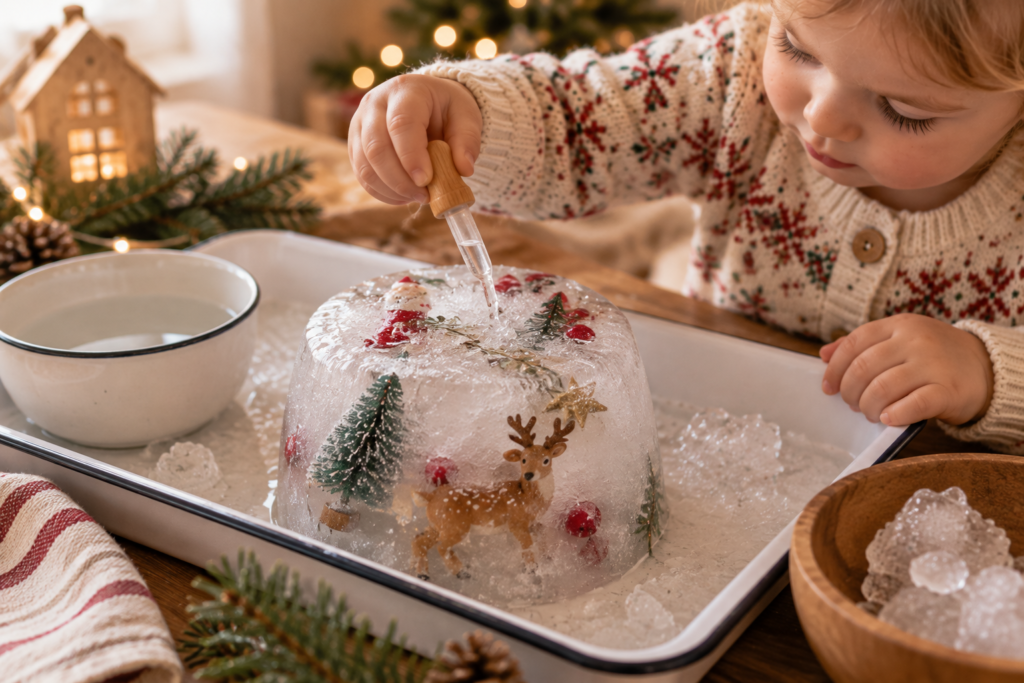
14. Frozen Christmas Rescue
Freeze a few large, child-safe objects in a shallow container of water.
Once frozen, put the block of ice into a tray.
Give your child warm water and a spoon or squeeze bottle and let them work out how to melt the ice.
What happens when warm water touches it?
Can they make a hole?
How long will it take for the object to come free?
Preschoolers often become completely absorbed in this.
Just avoid freezing small objects that could become choking hazards once released.
15. Melt the Christmas Ice
You don't actually need to freeze objects into the ice.
Make large ice cubes or festive ice shapes and put them into a tray.
Offer bowls of warm and cold water.
Let children investigate.
Which water melts the ice more quickly?
What does the ice feel like?
Can they pick it up?
Why does it keep slipping away?
It becomes a wonderfully simple sensory science activity without needing to turn playtime into a formal lesson.
Christmas Sensory Activities Using Smell and Nature
16. Christmas Scent Exploration
Christmas has some wonderfully distinctive smells.
Let children experience a few real, familiar scents with you rather than using heavily fragranced sensory products.
Depending on what you have, that might include:
• a whole orange
• freshly cut evergreen
• something you've baked
• cinnamon used during cooking
• gingerbread
• vanilla while baking
Talk about the smells naturally.
Does it smell sweet?
Fresh?
Spicy?
Does it remind them of anything?
There's no need to use essential oils in children's sensory play. The ordinary smells of Christmas provide plenty to discover.
17. Dried Orange Sensory Play
If you're already making dried orange slices for Christmas decorations, let your child investigate some with you.
Look at the patterns inside.
Smell them.
Compare a dried orange slice with a fresh orange.
Hold one up to the window and see what happens when light shines through it.
Preschoolers can also help thread suitable dried slices onto decorations with close adult supervision.
One Christmas preparation has suddenly become an activity too.
18. Evergreen Sensory Play
Evergreen branches are such a simple way to bring the season into play.
Let children touch and smell a small branch with you.
Look closely at the needles.
Compare it with leaves from other plants.
Preschoolers could use evergreen clippings as pretend trees in a small world or make nature pictures with them.
And when you're finished, they can go back outside or into your seasonal decorations rather than becoming another box of Christmas craft supplies you need to store until next year.
19. Pinecone Christmas Play
Pinecones are brilliant sensory objects.
They're rough, bumpy and interesting to examine.
Collect some during a walk and use them for open-ended play.
Children might:
• roll them
• sort them by size
• paint with them
• make pinecone Christmas trees
• use them in playdough
• add them to a nature tray
• pretend they're tiny trees
This is a particularly lovely way to connect outdoor play with indoor Christmas activities.
Christmas Fine Motor & Messy Sensory Play
20. Christmas Cookie Sensory Play
Instead of baking every time your child asks to make Christmas cookies, create pretend ones from playdough.
Roll out the dough.
Use cookie cutters.
Put the pretend cookies onto a baking tray.
Decorate them.
Serve them in a pretend cafe.
Then squash everything and start again.
There's no sugar rush, no pressure to make beautiful cookies and no disappointment when somebody eats the gingerbread person they spent 20 minutes decorating.
Save the real baking for another day.
21. Christmas Painting With Unusual Tools
Put away the paintbrushes and see what else can make marks.
Older children might experiment with a pinecone, evergreen clipping, sponge or cardboard edge.
What patterns do they make?
Can a pinecone be rolled through paint?
What happens when an evergreen branch is pressed onto paper?
Keep the colors simple and put down something washable underneath.
This is about experimenting with texture and movement, not producing a perfect Christmas picture.
22. Christmas Sticker Play
A sheet of large Christmas stickers can become several activities.
Toddlers can decorate cardboard.
Preschoolers can create Christmas pictures.
Draw a large Christmas tree and let children add sticker "ornaments."
Put stickers onto a cardboard box and turn it into a Christmas house.
Peeling and positioning stickers also gives little fingers plenty of work.
Make it toddler-friendly: Peel away the surrounding sticker backing first so individual stickers are easier to lift.
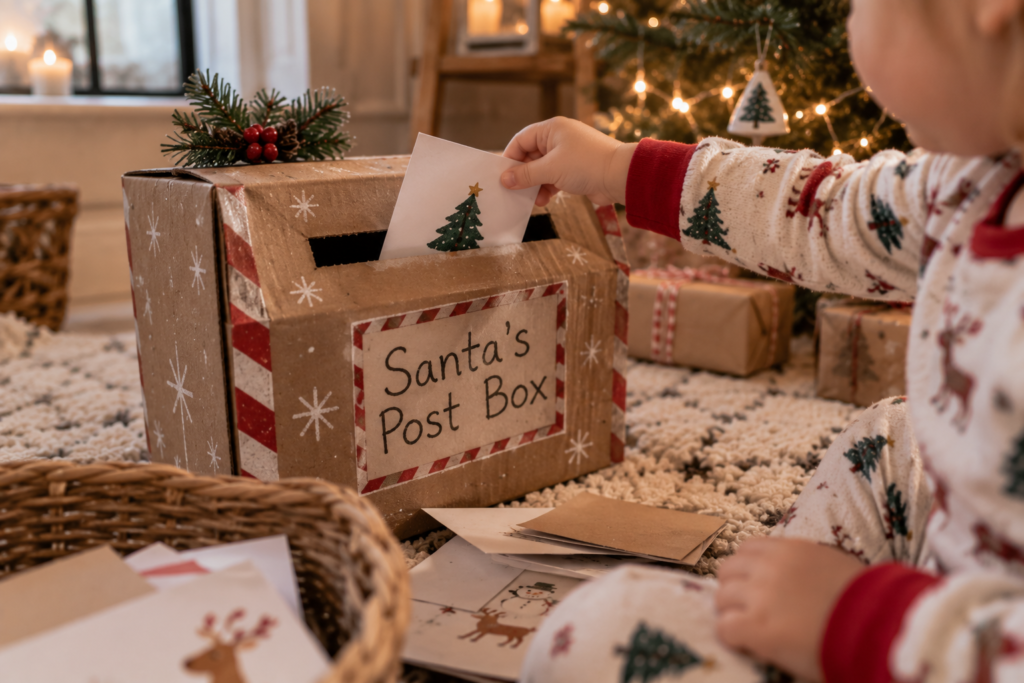
23. Christmas Posting Activity
Cut a wide slot into a cardboard box.
Give your child some large Christmas cards, postcards or pieces of decorated cardboard.
Now let them post the Christmas mail.
Once everything is inside, open the box.
Take it all out.
Start again.
Preschoolers can turn this into imaginative play by creating a post office for Santa.
Toddlers will probably be perfectly happy posting the same card 36 times.
Both approaches are valid.

24. Decorate a Giant Cardboard Christmas Tree
Cut a large Christmas tree from a cardboard delivery box.
Now put it on the floor or prop it somewhere safe and let your child decorate it.
Depending on age, you could offer:
• washable paint
• chunky crayons
• large stickers
• child-safe stamps
• pieces of paper
• washable dot markers
This is especially good if your toddler is desperate to decorate your actual Christmas tree.
They get a tree they're allowed to rearrange as much as they want.
Your real ornaments may even get five minutes of peace.
25. Christmas Baking Together
Real Christmas baking is sensory play too.
Children can smell ingredients, feel dough, stir mixtures, roll pastry and use cookie cutters.
Toddlers can help with one simple job, such as pouring a pre-measured ingredient into a bowl or pressing a large cookie cutter.
Preschoolers may be ready to do a little more.
And don't worry if they wander away before the cookies make it into the oven.
You don't need to force an activity to last longer just because it took you ten minutes to set up.
Their part can be finished.
You can finish the cookies.
Everyone wins.
What Are the Best Christmas Sensory Activities for Toddlers?
For toddlers, I'd choose simple Christmas sensory activities with large, age-appropriate materials.
Some of the easiest ideas from this list are:
• Christmas water play
• wrapping paper sensory play
• Christmas playdough
• a Christmas texture basket
• cardboard box play
• Christmas washing station
• large cardboard Christmas tree decorating
• baking together
Younger children don't need complicated sensory bins filled with tiny themed objects.
Simple materials give them plenty to explore.
What Are the Best Christmas Sensory Activities for Preschoolers?
Preschoolers may enjoy sensory activities with a little more imaginative play, problem-solving and independence.
Try:
• frozen Christmas rescue
• Christmas small-world play
• Christmas nature sensory bins
• Christmas cookie playdough
• pinecone painting
• Christmas posting play
• Christmas scent exploration
• pretend Christmas baking
• cardboard Santa's workshop play
Follow your child's interests.
If they're obsessed with water, do more water activities.
If they'd happily play with playdough every day until Easter, keep bringing out the playdough.
You don't need to constantly invent something new.

How Do I Make a Christmas Sensory Bin?
Start by asking yourself one question:
What does my child actually like doing?
If they love scooping, make a scoop-and-pour bin.
If they love animals, add familiar toy animals to a winter small world.
If they love water, forget the dry sensory bin entirely and make a Christmas water tray.
A simple sensory bin generally only needs:
1 sensory base + 1 or 2 tools + a few appropriate objects.
That's enough.
You don't need to buy a matching set of miniature candy canes, wooden Santas, acrylic snowflakes and 14 different colors of sensory rice.
In fact, having fewer materials can make the activity feel calmer and give children more space to decide what to do.
How Can I Make Christmas Sensory Play on a Budget?
Start with your house.
December already provides an enormous amount of sensory material.
Save wrapping paper.
Keep cardboard delivery boxes.
Use Christmas cookie cutters with ordinary playdough.
Borrow measuring cups from the kitchen.
Collect pinecones on a walk.
Use water.
Bring out the wooden spoon.
Reuse Christmas cards.
Use toys your child already owns.
Visit the library for Christmas books.
Sensory play doesn't need to arrive in a package labeled sensory play.
A lot of the best materials are ordinary things children don't usually get the opportunity to investigate freely.

A Simple Week of Christmas Sensory Play
If you like the idea of Christmas activities but don't want another complicated December schedule, choose just one easy activity each day.
For example:
Monday: Christmas playdough
Tuesday: Christmas texture basket
Wednesday: Christmas water play
Thursday: Wrapping paper sensory play
Friday: Christmas nature tray
Saturday: Christmas baking
Sunday: Forget the activity and go for a walk
Yes, Sunday counts.
You don't need to provide organized play every day.
Children also need time to simply play with their toys, potter around the house, go outside and be bored enough to invent something themselves.
You Don't Need to Create Christmas Magic Every Day
This might be my favorite reminder during December.
Our children don't need us to manufacture a magical childhood for them every morning.
Christmas is already pretty fascinating when you're little.
The tree suddenly has lights.
Interesting parcels appear.
There are songs everyone seems to know.
The house smells different.
People bake things.
There are shiny decorations everywhere.
And sometimes you're allowed to eat a cookie shaped like a person.
That's plenty of magic.
Use these Christmas sensory activities when you want an easy way to play together, fill a quiet afternoon or give little hands something interesting to explore.
Choose the ideas that suit your child and your home.
Use what you already have.
Let the activities be imperfect.
And if your carefully prepared Christmas sensory activity lasts four minutes before your toddler decides the cardboard box it arrived in is more interesting?
Let them have the box.
They've found their activity.