
Starting a t-shirt printing business is one of the most popular ways to step into entrepreneurship today. Custom apparel never goes out of style, and the demand for personalised designs only keeps growing. From online stores selling niche designs to local businesses looking for branded gear, the opportunities are endless.
But before jumping in, one of the biggest questions new entrepreneurs ask is: How much does it cost to start a t-shirt printing business? The answer depends on your printing method, your setup, and how large you want to scale. Some people begin with just a few hundred dollars, while others invest tens of thousands to build a full production shop. If you’re looking at options like an Epson Surecolor DTF printer, you’ll already see how different printing methods can drastically impact start-up costs.
Let’s break down what you can expect.

Factors That Influence Start-up Costs
Not every t-shirt printing business is the same. A home-based side hustle looks very different from a shop that handles hundreds of shirts a week. A few core factors affect your startup budget:
Printing method: Screen printing, heat transfer, direct-to-garment, or sublimation.
Business model: Owning your own equipment vs. using print-on-demand services.
Scale: Are you making a few designs at home or running a commercial operation?
Branding and niche: The more customized your designs, the more design tools, licenses, and marketing you’ll need.
Understanding these factors helps you build a realistic picture of what’s possible within your budget.
Estimated Costs by Printing Method
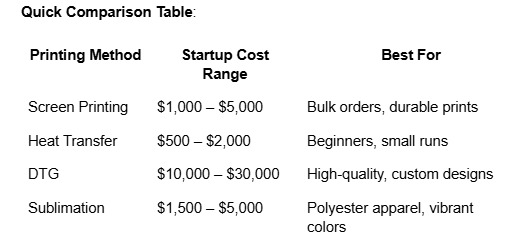
Different printing methods come with different expenses. Here’s a breakdown of what you can expect:
Screen Printing
Screen printing is a classic method that uses stencils and ink. It’s reliable and works well for bulk orders, but it requires multiple pieces of equipment.
• Equipment: Screens, inks, press, dryer.
• Typical cost: $1,000 to $5,000.
• Pros: Durable prints, good for bulk
• Cons: Not great for small runs or intricate designs.
Heat Transfer (Vinyl or Heat Press)
Heat transfer involves pressing vinyl or pre-printed transfers onto shirts. It’s simple, making it ideal for beginners.
• Equipment: Heat press, vinyl cutter (optional), transfer sheets.
• Typical cost: $500 to $2,000.
• Pros: Affordable entry point, versatile.
• Cons: Designs may peel over time, not ideal for high volume.
Direct-to-Garment (DTG)
DTG printers allow you to print directly onto fabric, producing high-quality images with little setup.
• Equipment: DTG printer, inks, pre-treatment equipment.
• Typical cost: $10,000 to $30,000.
• Pros: Photorealistic prints, no need for screens or transfers.
• Cons: Very high start-up costs, ongoing ink expenses.
Sublimation Printing
Sublimation uses heat to transfer dye onto polyester shirts or blends.
Equipment: Sublimation printer, ink, heat press.
Typical cost: $1,500 to $5,000.
Pros: Bright, permanent designs.
Cons: Limited to polyester or specially coated garments.
Additional Business Expenses
Equipment is just part of the cost. Don’t forget these essential extras:
• Design software: Adobe Illustrator, Photoshop, or free tools like GIMP (ranging from free to $60/month).
• Inventory: Blank shirts can cost $2–$5 each depending on quality. Buying in bulk lowers cost.
• Marketing & branding: Expect at least $200–$1,000 for a website, logo, and social media ads.
• Licenses & permits: Business registration may cost $50–$500 depending on your state or country.
• E-commerce platforms: Shopify and Etsy come with monthly fees or commissions.
These hidden costs can quickly add up if you don’t plan ahead.
Print-on-Demand vs. Owning Equipment
One major decision is whether to invest in your own equipment or use a print-on-demand (POD) service.
• Print-on-Demand: You upload your designs, and a third party prints and ships shirts. Start-up costs are nearly zero, but margins are smaller (profit per shirt may be only $5–$7).
• Owning Equipment: High upfront cost but much higher control and margins. For example, you could profit $10–$15 per shirt depending on volume.
If you’re testing the waters, POD is the cheapest way to start. If you’re serious about long-term growth, owning equipment pays off.
Tips to Keep Costs Low
Not ready to invest thousands? Here are some smart ways to keep startup costs manageable:
• Start with heat transfer or POD before moving to advanced setups.
• Look for used equipment—many print shops sell lightly used gear at a fraction of the cost.
• Outsource printing to a local shop until you scale.
• Focus on niche markets so you can charge higher prices and sell fewer shirts to cover costs.
With careful planning, you can launch with less than $1,000.
ROI and Profit Potential
Here’s the exciting part: profit margins in t-shirt printing can be strong. On average, blank shirts cost $2–$5, and printing adds another $1–$4 depending on method. Selling price? Usually $15–$25.
That means you could earn $5–$15 profit per shirt.
Example: If your start-up cost is $2,000, you’d only need to sell around 200 shirts at a $10 profit to break even. Of course, marketing and overhead factor in, but the potential for a strong return on investment is real.
For larger setups, the math still works—though you’ll need higher volume to offset the bigger equipment investment.
Conclusion
So, how much does it cost to start a t-shirt printing business? The answer ranges from as little as $500 to more than $30,000, depending on your approach. A heat transfer setup or print-on-demand model can get you started on a tight budget, while a DTG or screen-printing shop requires more serious investment.
The key is to match your budget with your business goals. If you’re experimenting or running a side hustle, low-cost methods work well. If you’re aiming to build a brand and scale, investing in professional equipment can set you up for long-term success.
With a clear plan and realistic expectations, you can turn the simple idea of printing shirts into a profitable business.